A shot from 11 meters gives you barely any time to think. In that split second, your eyes must track the ball, your brain must calculate its trajectory, and your hands must be in exactly the right spot. Not just roughly right. Exactly right.
That’s exactly what hand-eye coordination in goalkeeper training is all about: the ability to translate what you see into the correct hand movement without delay. It’s not a matter of talent—something you either have or don’t have. It’s a skill that can be trained. The problem: most goalkeepers never train it specifically. They rely on it “coming naturally over time.” It doesn’t. It comes with the right amount of repetition.
The ball is coming. Your hands know it before you even think about it. Or they realize it too late.
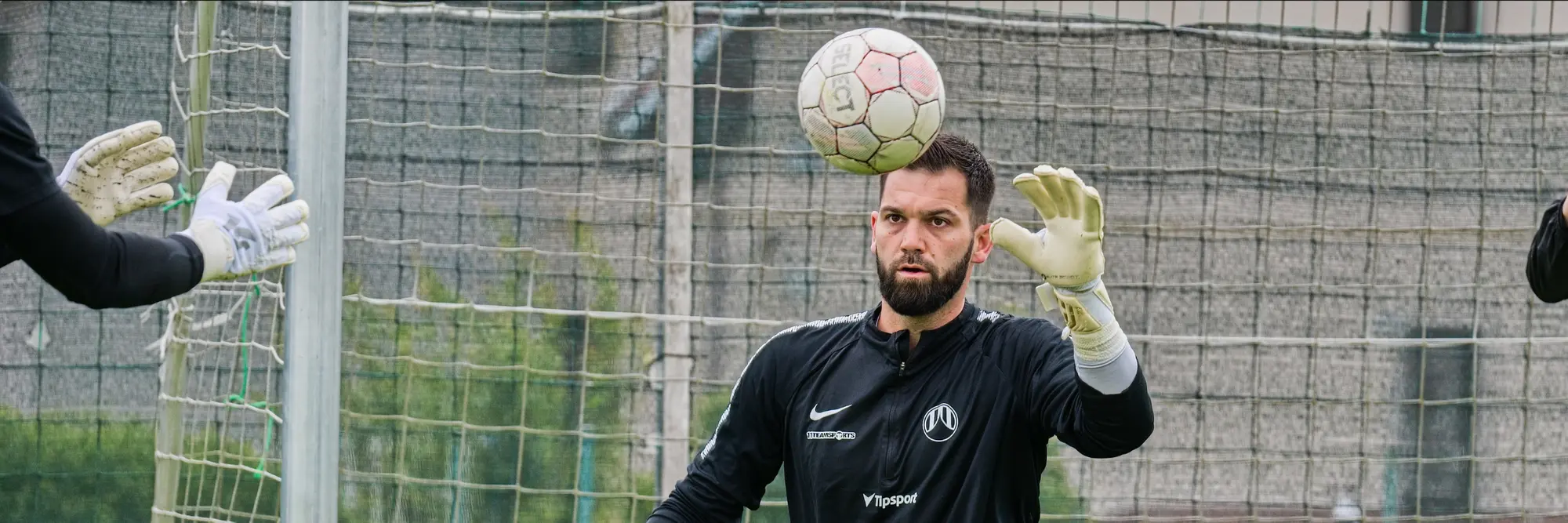
Why Hand-Eye Coordination Is in a League of Its Own for Goalkeepers
Every athlete needs hand-eye coordination in one form or another. For a goalkeeper, it’s not just one skill among many—it’s the foundation on which everything else is built. Diving technique, anticipation, reflexes—none of it matters if your hands don’t end up where the ball is.
What this means in practical terms: Your visual system must track the trajectory of a ball that’s moving at over 100 km/h, spinning, deflecting, or changing its flight path due to wind and impact. At the same time, your motor system must translate this information into a precise hand movement, often while your body is still in the air or diving to the side.
This fundamentally sets you apart from a field player. A field player controls a ball that mostly stays on the ground and whose speed they help determine themselves. You react to a ball whose speed, spin, and direction are determined by someone else, and you don’t get a second chance.
The three components of hand-eye coordination
Visual tracking. The ability to follow a moving ball with your eyes without interruption, even when it changes course. If you lose sight of the ball just before it hits the ground—and this happens more often than you might think—you’ll miss the very moment that determines whether you make the save or concede a goal.
Anticipating the trajectory. Your brain must not only see where the ball is, but also predict where it will be in the next instant. That’s the difference between chasing after it and getting there first.
Motor precision under time pressure. The information is worthless if your hand doesn’t go exactly where it needs to—with the correct hand position—at the right moment. That’s exactly what you’re training when you do reaction drills with a real ball instead of just verbal cues.
Why this is important: If you focus on only one of these three building blocks, you’ll remain prone to mistakes. A goalkeeper with excellent tracking but poor motor precision will see the ball coming perfectly and still fail to hold onto it. Good training combines all three.
The Most Common Mistakes in Coordination Training
Only practice when the coach announces it. If the coach tells you in advance where he’s going to throw the ball, you’re practicing execution, not coordination. The ball must come without warning; otherwise, the actual training stimulus is lost.
Too late in the warm-up. Coordination training belongs at the beginning of the session, when the nervous system is still fresh. At the end of an exhausting session, your system will only learn poor patterns.
Always the same distance, the same angle. Your body gets used to fixed stimuli and stops truly adapting. Varying the distance, throw height, and ball speed keeps the training stimulus high.
No distractions. If you only see the ball—without environmental stimuli like backlighting, opponents in your field of vision, or a second ball—you’re training under laboratory conditions that don’t exist in a game.
3 Exercises for Better Coordination Training in Goal
Drill 1: Catching a Reaction Ball
Setup: A reaction ball (an irregularly shaped ball with an unpredictable bounce) or, alternatively, a tennis ball. The coach throws the ball or lets it bounce on the ground in front of the goalkeeper from a distance of 2 to 3 meters.
Procedure: The goalkeeper must catch the ball after its unpredictable bounce, without knowing in advance which direction it will bounce.
Why it works: The erratic bounce forces the eyes and hands to make real-time adjustments instead of tracking an expected trajectory. This ability to adjust is exactly what you need when dealing with deflected shots and erratic balls during a game.
Drill 2: Double Ball Throw
Setup: Two coaches, or one coach with two balls, stand 3 to 4 meters in front of the goalkeeper. Both throw the balls in quick succession—sometimes simultaneously, sometimes staggered—at different heights and in different directions.
Procedure: The goalkeeper must track both balls, prioritize which one is coming first, and either catch or block both cleanly.
Why It Works: In a game, attention is rarely focused on a single stimulus. This drill trains divided attention and quick decision-making in addition to pure catching technique.
Drill 3: Color Throw with a Delay
Setup: The coach holds two balls of different colors, out of the goalkeeper’s direct line of sight. The color becomes visible only at the moment of the throw.
Procedure: The goalkeeper must recognize the color at the last moment and react accordingly—for example, catching the red ball or blocking the blue ball.
Why It Works: The delayed reveal of information precisely simulates what happens in a game: you often don’t see the crucial details—launch angle, point of contact, spin—until the very last moment. Players who have practiced this won’t waste valuable time thinking during a game.
Your Coordination Checklist
✅ Do coordination drills at the beginning of the session, not at the end.
✅ Never throw with a warning—the stimulus must come without warning.
✅ Vary distance, height, and speed regularly.
✅ Include at least one drill per week with a real disruptive stimulus.
✅ Quality over quantity—10 clean repetitions are better than 30 rushed ones.
Conclusion: The hands simply follow what the eye has trained them to do
No goalkeeper is born with perfect hand-eye coordination. It develops through thousands of targeted repetitions, during which the eyes, brain, and hands learn to work as a single system rather than as three separate steps.
Anyone who thinks this comes naturally through regular training is missing the point of the actual skill. Those who train it specifically regain exactly that split second that ultimately makes the difference between a save and a goal.
Always stay up to date
Frequently Asked Questions About Hand-Eye Coordination in Goalkeeper Training
Is it even possible to train hand-eye coordination as a goalkeeper?
Yes. It is not an innate ability, but rather a combination of visual tracking, anticipation, and motor precision that improves through targeted repetition.
How often should I incorporate coordination training?
It's more effective to exercise regularly and for short periods than rarely and for long periods. One or two focused sessions per training week, right at the start of the workout, are enough to make noticeable progress.
At what age does coordination training become beneficial?
The sooner, the better. The window of opportunity for the development of coordination is widest during childhood, but even adult goalkeepers show measurable improvement with targeted training.