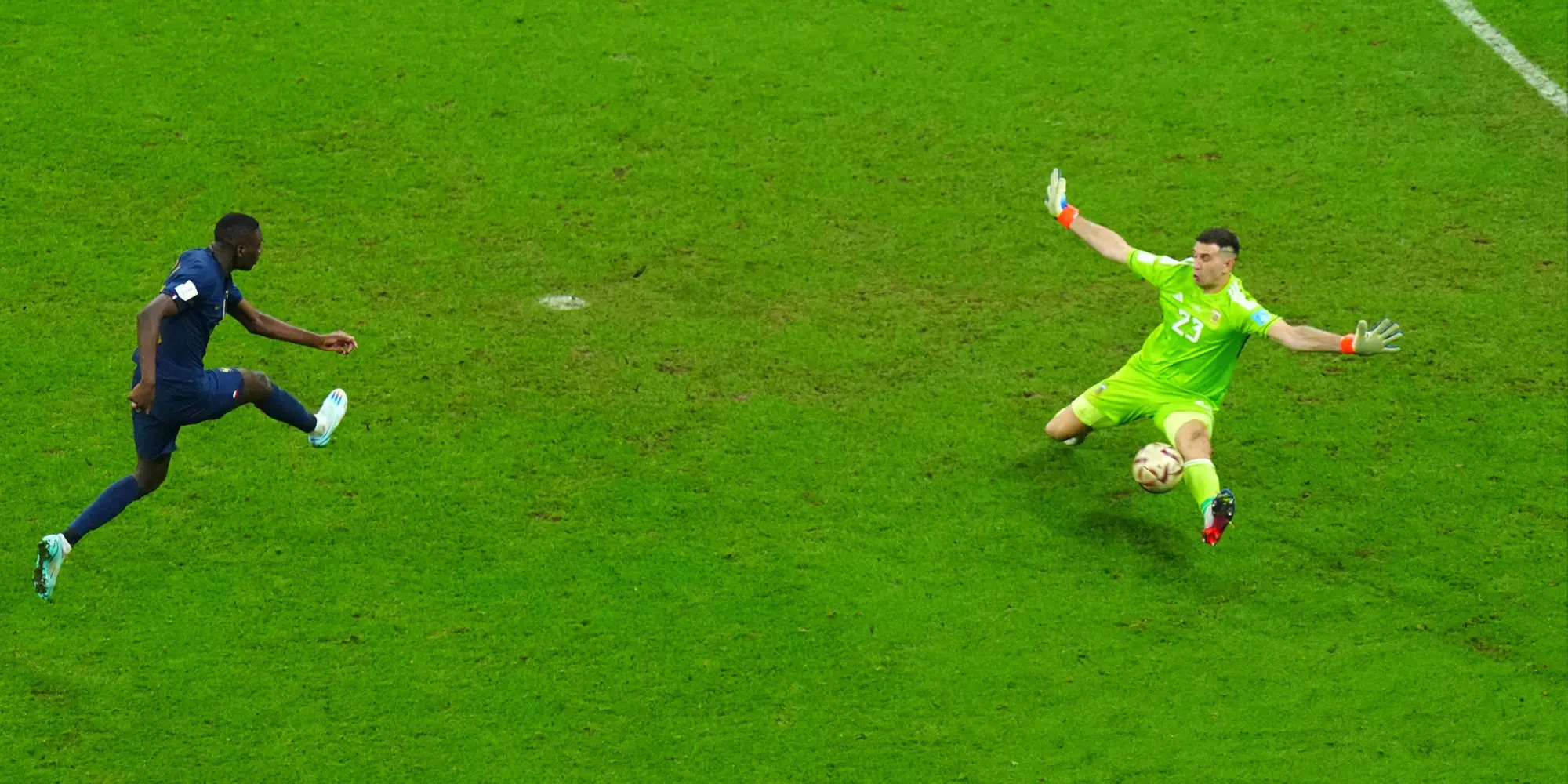
Randal Kolo Muani breaks free from the defense. A clear path. Only the goalkeeper stands in his way. One goal, and France is the world champion. All of extra time, every minute of training over the years, comes together in this one moment.
Emiliano Martinez sprints out, spreads his body wide, and narrows the angle. Kolo Muani takes the shot. The ball hits Martinez’s leg. No goal. A short time later, Argentina is crowned world champion in a penalty shootout.
This single scene is remembered as a reflex. But it wasn’t. It was the result of the right decision, perfect timing, and a goalkeeper who knew exactly what he was doing in that one-on-one situation.
On a long-range shot, the situation is set the moment the ball leaves your foot. In a 1-on-1, it isn’t. The attacker doesn’t make his decision until after you’ve already started to act. He reacts to what you do, and you react to what he does in response. It’s a real-time duel, not a static save.
This means: If you train for 1-on-1 situations by simply “getting out quickly and blocking the ball away,” you’re missing the point of the actual skill. The goal is to force the attacker to make a decision, not just to react to his.
Every 1-on-1 duel can be divided into two phases.
The action phase. Here, the goalkeeper actively occupies and fills the space before the shot is even taken. Coming off the line, closing down angles, timing the step. This is the phase that usually decides victory or defeat in the duel long before the ball leaves the attacker’s foot.
The reaction phase. Here, the body reacts solely to the ball itself: blocking technique, catching the ball while falling, leg or hand reaction. This is the part that ends up in photos, but without the preparatory action phase, it often doesn’t even come into play.
Why this is important: If you train only the reaction, you’re training the result, not the cause. A goalkeeper with perfect blocking technique who comes out too late or at the wrong angle never even gets into the position where that technique can be effective.
With Martinez, it happened in exactly this order: action first, in the form of a burst of speed and closing the angle; reaction afterward, in the form of the blocking technique with his leg—low and wide—to cover the largest possible area.
A goalkeeper doesn't need flawless technique just to show it off in practice. He needs it so that, when the moment of truth arrives, he can draw on it in a fraction of a second without having to think.
What this means for your training: Analytical technique training has its place, but only to the extent necessary. The majority of training time should be devoted to situational application—at game speed and under conditions of real uncertainty—just as the game demands.
Timing of the challenge. Too early, and the attacker will chip the ball over you or cut around you. Too late, and you won’t be able to get to the ball. The right moment is when the attacker no longer has the ball right at his feet but hasn’t made his next touch yet.
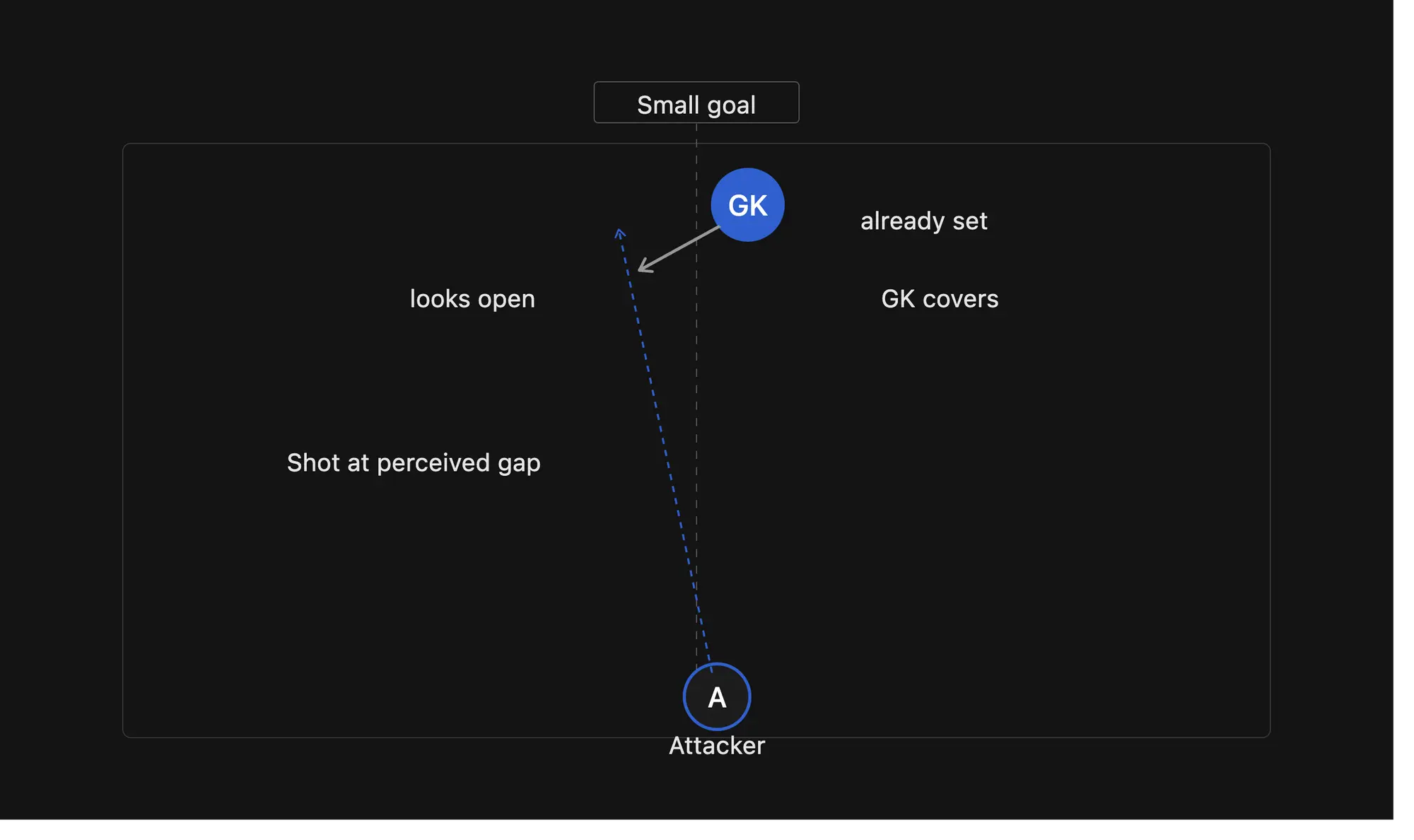
Close down the angle, don’t just cover the area. Martinez didn’t just run straight toward Kolo Muani. He positioned himself so that one side appeared to be open, when in reality he was controlling it. The attacker should think he sees a gap that isn’t really there.
Force the decision, don’t wait it out. A passive goalkeeper who merely makes his area smaller leaves the attacker with all options: a shot, a chip, or a cross. A goalkeeper who actively picks up speed and plants a foot in the space takes one of those options away before the attacker even considers it.
Why it works: An attacker in a sprint makes his final decision in a fraction of a second, usually based on what he saw last. A goalkeeper who actively shapes the play rather than merely reacting helps determine that final impression.
Not every one-on-one situation is defended the same way. Two techniques come up particularly often in 1-on-1 situations.
The small cross. When the ball is close to the attacker’s foot, the entire body moves toward the ball as a block. Keep your eyes on the ball; do not turn your upper body; quickly lower your knee toward the heel of your opposite foot. The heel of your supporting foot lifts slightly as you do this. This technique relies on being executed very quickly and is used when the ball is about one to one and a half meters away.
The ball challenge. Here, the goalkeeper actively moves toward the ball instead of merely blocking the area, usually to deny the attacker that final touch before he can even take a shot. This is exactly the approach Martinez used in the game: not waiting passively, but stepping into the situation himself and forcing the attacker to make a decision.
Why it works: The closer the ball is to the attacker, the less time you have to execute the technique. If you haven’t automated the right technique for the right distance, you’ll often choose the wrong one under pressure and lose the duel by a matter of millimeters.
Coming out too late. If you wait until the attacker is already taking a shot, you’ve already lost the battle before you even had a chance to make a decision.
Rushing out recklessly. Full speed without controlling the angle isn’t 1-on-1 defense—it’s a sprint into danger. The attacker just has to pass the ball by you.
Always the same solution. If you defend every 1-on-1 the same way, you become predictable to good attackers. Varying between staying put, coming out early, and playing the angle is essential.
No training at game speed. 1-on-1 drills at a walking pace prepare you for nothing. In a real game, the attacker comes at you at full sprint, not at a leisurely pace.
Drill 1: The Kolo-Muani Drill
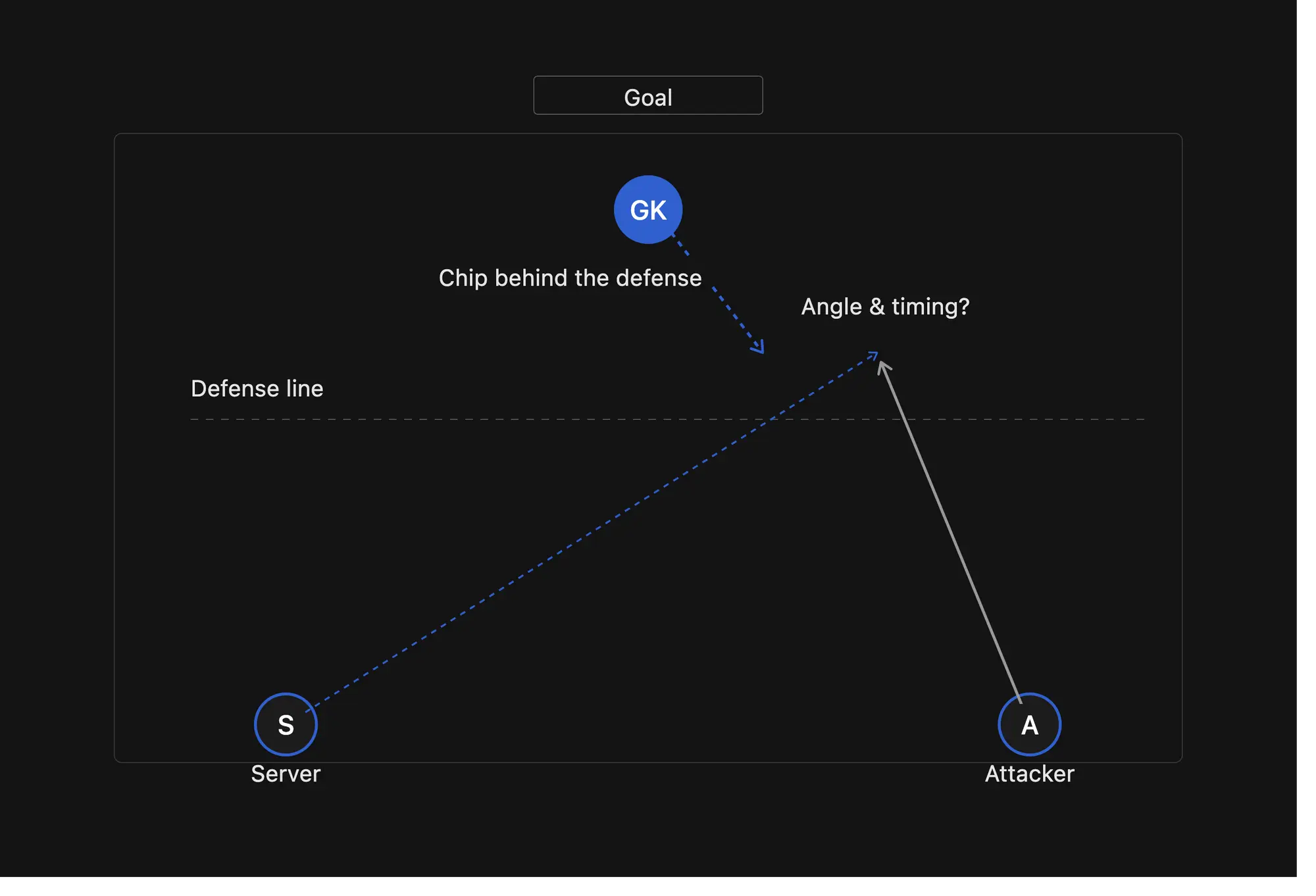
Setup: A passer chips or slips the ball behind the defense, and an attacker sprints toward it. The goalkeeper must assess the situation from scratch, without knowing in advance from which angle the attacker is coming.
Procedure: The goalkeeper decides in real time whether to come out, when to do so, and what body position to use to close down the angle.
Why it works: It is precisely this basic scenario—the ball behind the defense, a single attacker, and no coverage—that decides close games like this final. Those who have experienced it often enough will make the decision faster when it really counts.
Drill 2: Faking an Opening
Setup: Goalkeeper and attacker in a 1-on-1 situation on a smaller goal. The goalkeeper is tasked with deliberately choosing a position that makes one side appear more open than it actually is.
Procedure: If the attacker aims for the supposed gap, the goalkeeper must already be positioned right there.
Why it works: You’re practicing active deception rather than passive waiting. That’s exactly what made the difference in the final: The attacker shot where the goalkeeper wanted to lure him.
Drill 3: Decision-Making Under Time Pressure
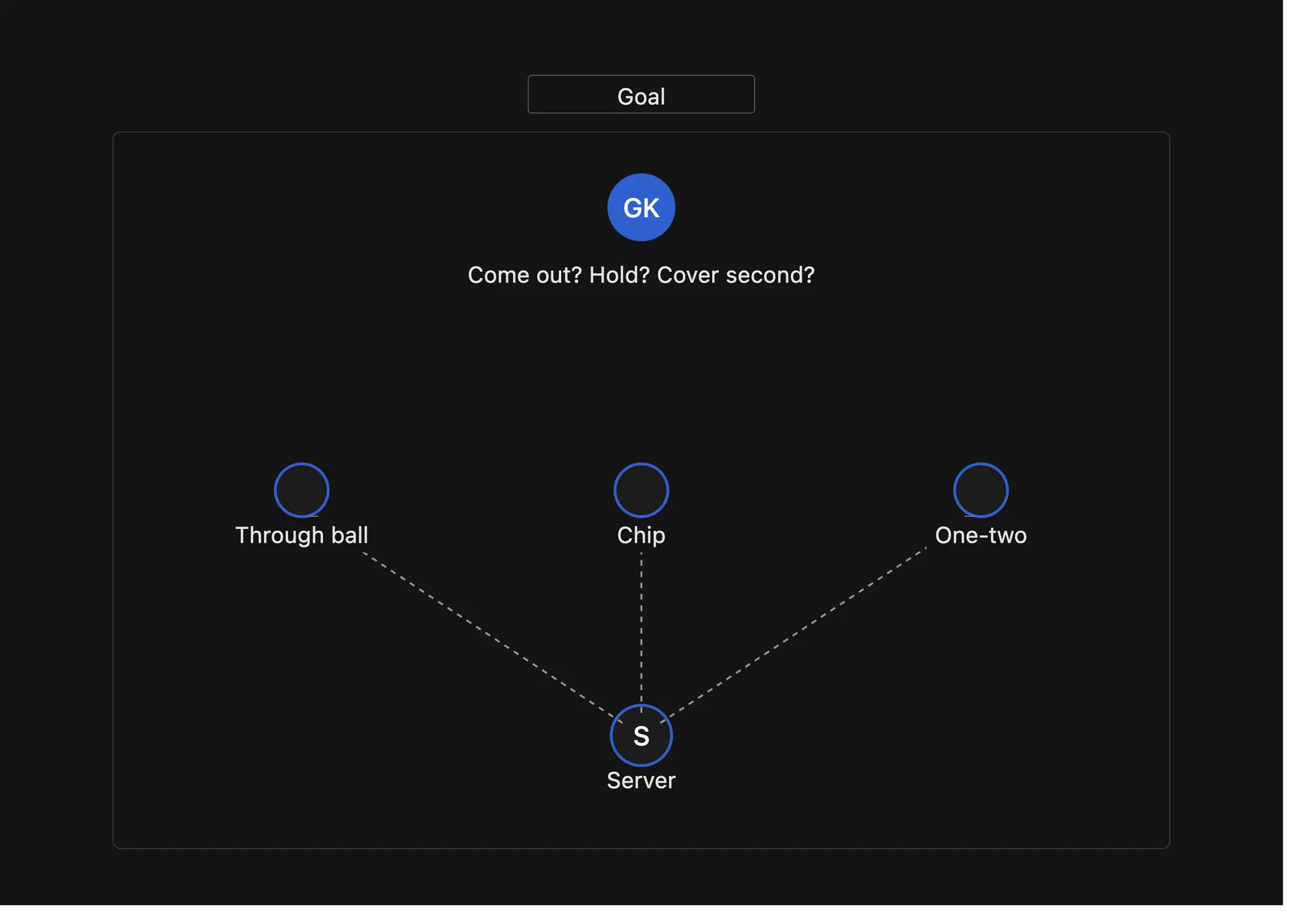
Setup: The passer randomly alternates between a through ball, a chip shot, and a give-and-go with a second attacker. The goalkeeper doesn’t know which situation will actually arise until the last moment.
Procedure: The goalkeeper must decide whether to come off the line, stay put, or cover against the second attacker, without knowing in advance which option will arise.
Why it works: In a real game, the initial situation is rarely straightforward. Goalkeepers who train only for clear through passes will be overwhelmed as soon as a second attacker or a different passing option enters the play.
✅ Train the timing of breaking free specifically, not just speed
✅ Use angle play as an active tool, not just for coverage
✅ Consciously create “gaps” that aren’t
really gaps ✅ Always perform 1-on-1 drills at full sprint speed, never at a walking pace
✅ Incorporate variety: through balls, chip shots, and give-and-goes, so that decisions are never made automatically
The scene with Kolo Muani will forever be remembered as the moment when Martinez saved the World Cup title. But the real feat wasn’t the reflex when he touched the ball. It was the decision made a fraction of a second before: when to come out, what angle to offer, how to direct the attacker.
That’s exactly what can be trained. Anyone who practices 1-on-1 situations consciously and at game speed won’t have to improvise in the decisive moment. They’ve already been through that scenario—just in training.
As a goalkeeper, when should I come off my line?
The right moment is just before the attacker makes his next touch, not after. If you move too early, he still has time to dribble past you or chip the ball over you. If you move too late, you're just a spectator when he takes the shot.
Is it enough to just step out quickly and boldly?
No. Speed without spatial awareness isn't 1-on-1 play—it's a reckless sprint. What matters is how you position your body on the field, not just how fast you get there.
How do I practice offering a fake opening?
It works best in controlled 1-on-1 drills, where you deliberately leave one side more open but are already positioned there. Over time, this deliberate decision becomes an automatic response.
What should I do if two attackers are coming at me at the same time?
Then the priority shifts: You first need to determine whether the player with the ball will shoot or pass across before you decide on a move. This is exactly what you can practice specifically in training using different one-two combinations.
How often should 1-on-1 drills be included in practice?
At least once a week at full sprint speed and with varying passing patterns. If you practice 1-on-1 only occasionally and at a walking pace, you won't be able to apply that training to the game.
Read more:
- Goalkeeper Training Reimagined: Why General Training Won’t Make You Better -
Improving Your Reaction Time—How to Train Like a Pro -
Hand-Eye Coordination: The Underestimated Skill That Determines Whether You Save the Shot or Concede a Goal